
Stop Letting Dating Apps Use You: The Psychology of Taking Back Control.

The Promise of Connection
Dating apps promise connection. Yet for many people they create a strange paradox: the more we swipe, the less connected and more lost we often feel.
People describe cycles of excitement, curiosity, disappointment and sometimes even exhaustion. A match appears, a conversation begins, and then suddenly it disappears again. Over time, the experience can begin to feel less like meeting people and more like participating in an algorithm.
This is not entirely accidental.
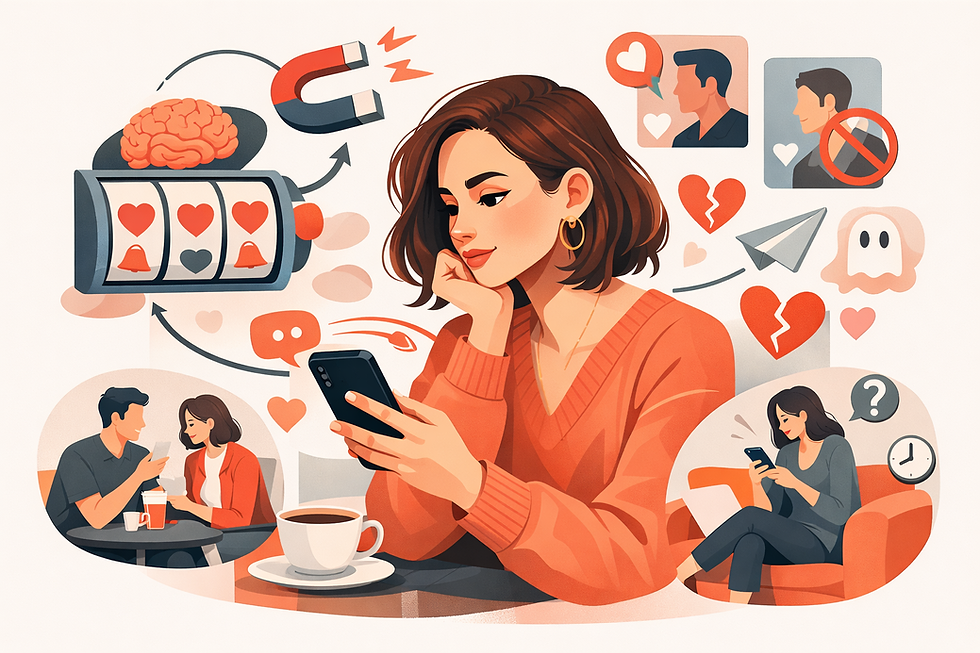
Many dating apps are built around the same psychological mechanisms used in social media and gaming: dopamine-driven reward loops and variable reinforcement schedules. Matches appear unpredictably, messages arrive intermittently, and occasional moments of validation keep us returning to the app.
Understanding this dynamic can be surprisingly empowering. The goal is not necessarily to abandon dating apps, but to learn how to use them consciously rather than being subtly used by them.
Below are several psychological principles that can help shift the dynamic.
1. Recognise the Dopamine Loop
Dating apps are designed to encourage repeated engagement. The unpredictability of matches and messages activates the brain’s reward system in a similar way to slot machines: occasional positive feedback keeps us swiping.
The danger is that the app becomes a source of stimulation rather than a tool for meeting someone.
A helpful shift is to treat dating apps as intentional tools rather than environments to live in.
Practical approach:
• Set specific times to check the app
• Avoid constant background swiping
• Move conversations towards real interaction sooner rather than later
The purpose of the app is simply to open a door to a real conversation.
2. Be Aware of Attachment Patterns
Dating apps can amplify existing attachment dynamics.
There is a little more to attachment styles than this simple classification, but being aware of your usual/ automatic, (possibly outdated) response scripts can give you a sense of freedom and encourage choice and a different outcome in interaction.
For example:
App Behaviour & Possible Attachment Response:
Constantly checking messages = anxious attachment activation
Slow or intermittent replies = avoidant patterns
Push–pull communication = disorganised dynamics
What would it be like to do something different or think it through before you respond ?
Because apps create gaps, delays, and ambiguity, they can activate the attachment system very quickly.
Sometimes the emotional intensity people experience on apps is less about the person themselves and more about the psychological uncertainty of the environment.
Recognising this can help bring a little more calm and perspective to the process.
3. Notice the Category Trap
One of the hidden dynamics of dating apps is that they encourage us to sort people into rapid categories.
Within seconds we might decide:
• too short
• too old
• too serious
• too casual
• not my usual type
These decisions often feel rational, yet they are frequently based on very limited information.
In clinical conversations I have daily, it is striking how often people say something like:
“If I’m honest, I probably would have swiped left on my partner if I had seen them on a dating app.”
This observation highlights something important about how relationships actually develop.
Real connection tends to grow through humour, shared experiences, conversation, emotional presence and a ‘slower burn’ than a specifc characteristic. These elements cannot be captured in a handful of photographs, a short biography and a set of stats.
Dating apps compress human evaluation into a few seconds. Real relationships unfold through curiosity.
Which leads me on to our next point...
4. Question What You Think You Want
I hear this a lot! Many people approach dating apps with a mental checklist.
A certain profession.
A certain height.
A particular lifestyle.
A defined “type”.
Yet the qualities that tend to sustain a relationship are often quite different:
• emotional stability
• kindness
• curiosity
• reliability
• the capacity for intimacy
These deeper relational qualities are difficult to assess through a profile.
As a result, people sometimes swipe away individuals who might actually offer the type of connection they are looking for.
This does not mean abandoning preferences entirely. Rather, it means allowing space for curiosity.
Instead of asking:
“Is this my usual type?”
A more useful question may be:
“Is there enough here for an interesting conversation?”
5. Move the Interaction into Real Life Sooner
Dating apps are not designed for sustained connection. They are designed to keep people inside the platform.
Meaningful interaction tends to develop when communication moves into more natural contexts: a phone call, a walk, or meeting for coffee.
A useful principle is simple:
Use the app to meet people, not to maintain relationships within the app.
6. Protect Your Sense of Self
One of the most subtle dangers of dating apps is that they can gradually shift how people evaluate themselves.
Matches, replies and silence can begin to feel like measures of attractiveness, desirability or worth.
In reality they are often reflections of algorithms, timing, attention spans and the emotional availability of the other person.
Dating apps are filtering tools. They are not mirrors of personal value.
A Final Thought
Dating apps are not inherently good or bad. They are simply environments shaped by particular psychological incentives.
When used unconsciously, they can create cycles of validation-seeking and frustration.
When used deliberately, they can become useful gateways to meeting people outside our usual social circles and locations.
The key shift is simple but powerful:
Stop treating the app as the experience. Treat it as the introduction.
If you would like any support navigating the dating landscape, have 'dating app burn out' or are curious about understanding your attachment scripts, please feel free to reach out to me on: hello@emilymitchelltherapy.co.uk

Comments